
Books Read: Something To Answer For by P.H. Newby
It's the Suez!

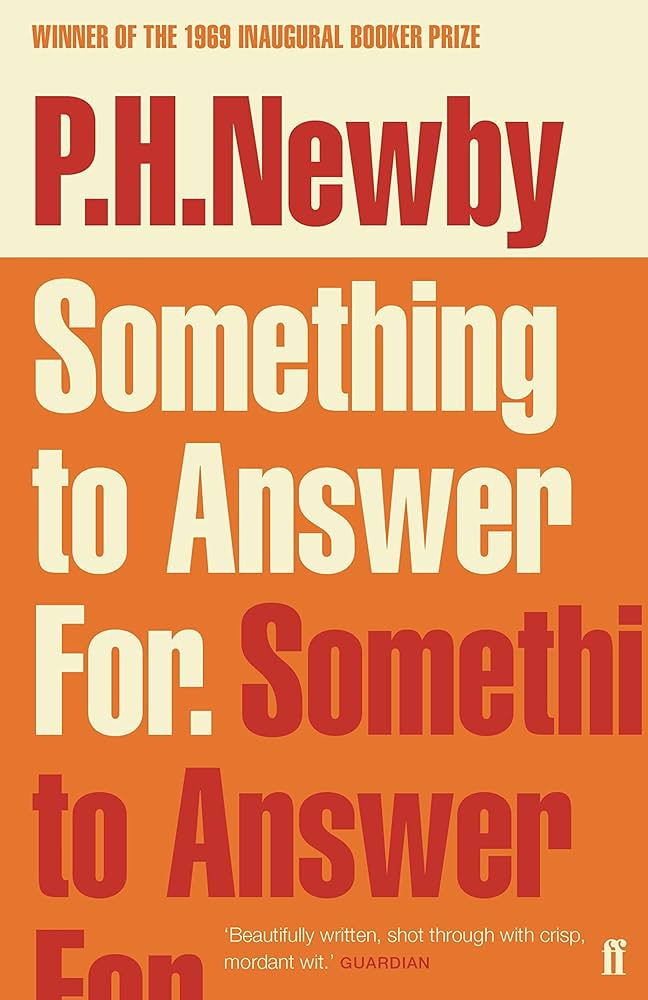
What an odd book. What an odd, weirdly prescient book. What an odd, weirdly prescient book to win the very first Booker Prize in 1969.1
P.H. Newby’s Something to Answer For centres on Townrow, a British citizen who returns to Egypt (Port Said, to be precise) following the death of his friend/colleague/partner-in-crime, Elie Khoury.2 He visits a local Cyprus bar, gets completely plastered, and wakes up the next morning “quite naked… the top of his head... smashed in.” From that point on—and we’re talking twenty pages into the novel—Townrow doesn’t so much become an unreliable narrator (who claims to be Irish) as an incoherent one. He has an identity crisis, is paranoid, hallucinates, lies and is awful to women (well, that might just come naturally to him), and, because it’s 1956, somehow stumbles through—not entirely unscathed, acquired brain injury aside—the Suez Crisis.3
I can’t say I enjoyed reading this novel, but that doesn’t mean I disliked it. Newby’s commitment to the bit, a refusal to fall back into a conventional linear narrative, is great. It makes for this hypnotic reading experience, where you read five, ten, fifteen pages and are not entirely sure what’s happened or where you are in time (not space). Townrow’s memories, like the narrative, are a shambles.
There are moments of clarity, including an astonishing scene early on in the novel, in which Townrow, on his way to Egypt, meets an Israeli in a bar at Rome airport. There, the Israeli berates Townrow for the Allies not doing more to warn Jews about the concentration camps.
The Israeli was impatient. His eyes had not left Townrow’s face. “The question I put is this. We listened every night to the B.B.C. Very good. You know what would happen if we were caught listening to the B.B.C.? Death. We all listen. We sit in the dark, and so I sat in the dark with my father and my uncle. At no time, I tell you, did the B.B.C. warn us about those trains. It is useless to deny it. Why was there no warning? We Jews did not know. We were told the men went to Germany to work in factories and on the land. Why did the British not say, ‘Stay away from those trains. Do not go on those trains. They are death trains. They will take you to the extermination camps.’? If the British had said this, my father and my uncle, do you think they would have gone? They would have killed themselves first. They would have gone across the river into Yugoslavia.
Then, around three-quarters of the way through, the Suez Crisis erupts, and a confused, doddering Townrow is caught in the middle of the violence. The scenes here are vivid and visceral, with Townrow’s perspective narrowing down to a desperate need to stay alive, to outrun the bullets.
Reading this now, with the war in Iran and the closure of the Strait of Hormuz, the novel seems almost prophetic, until you realise that history is prone to repeating itself.
Something to Answer For has its flaws: a fragmented plot, a truly awful protagonist (he’s a racist as well), and whole paragraphs that fold in on themselves. Actually… for some, those will be strengths. The point is, it’s a novel where you have to do most of the heavy lifting and, as such, it isn’t going to be to everyone’s (most people’s) taste. But the more I’ve thought about Something to Answer For, the more I’ve flicked through its pages for this review, the more I’ve come to appreciate what Newby was seeking to achieve. It’s a Booker winner that has almost been forgotten, and maybe that should change.4
***This is one of those novels that makes clear its intent from the opening, discombobulating paragraph. Of course, you only come to realise this after the fact.
As part of their hiatus, Backlisted, a podcast I have never mentioned and will never mention again, is reviewing one Booker winner a month via a process called posh bingo (basically, Andy Miller randomly chooses the next winner from a bucket, AKA the “Gilded Amaretti Posh Bingo Tin of Destiny”). It’s for Patreon peeps only. There’s also a live recording of the discussion with Miller, John Mitchinson and Nicky Birch (which I can’t attend because I live in the wrong hemisphere, story of my life really). They are two episodes in, and so far it’s been enormous fun.
When he enters the country, he jokes, in poor taste—a trait we will never entirely get used to—that he’s here to marry Khoury’s wife. “She’s sixty at least,” he says. “She’s got a moustache.”
This is one of those novels that makes clear its intent from the opening, discombobulating paragraph. Of course, you only come to realise this after the fact.
Admit it, you had never heard of this novel, had you?
Ugly cover contrasted with a misleading quote which makes it sounds pretty and fun 🙄