
The Recollections by Christopher Priest, edited by Nina Allan.
A luminary of the field.

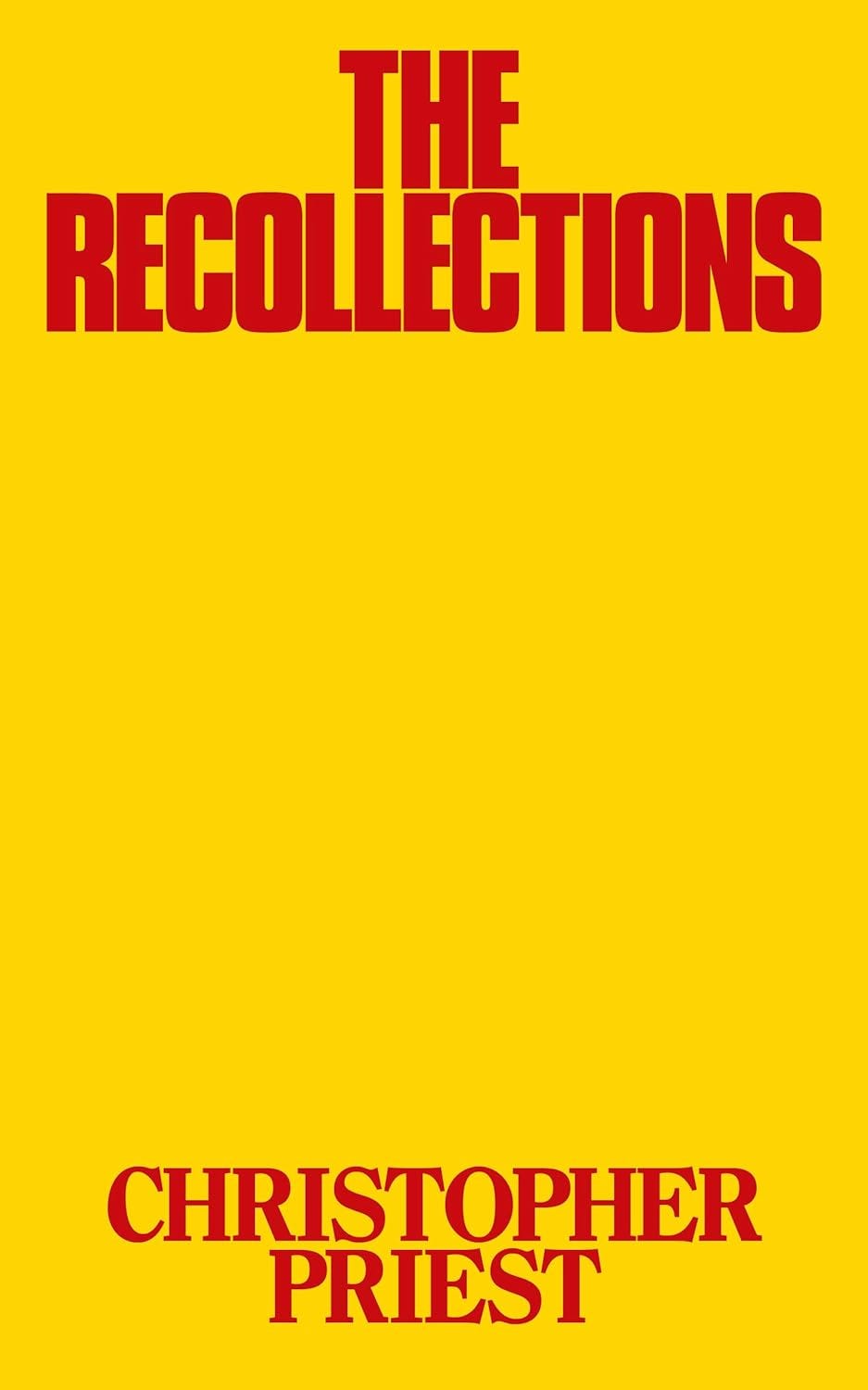
The Recollections is the first of two posthumous books by Chris Priest to be published in 2026. The second is The Illuminated Man: Life, Death and the Worlds of J.G. Ballard. I have read both, and, in very different ways, they are remarkable achievements. If I still voted for the Hugo Awards, I would need to toss a coin to split them in the “best related work” category.
Priest’s wife, Nina Allan, was instrumental to both works. She edited The Recollections and co-wrote The Illuminated Man. Her involvement with the latter, about which I will have more to say in an upcoming review, is extraordinary, a word I use far too often, but never meant more here. Her hand in shaping The Recollections, which comprises sixteen essays written by Priest, may not be as overt, but it is still profound. I got the strong impression, partly from Allan’s introduction and partly from the essays themselves, that some of these pieces, especially those dealing, albeit briefly, with Priest’s personal life and his take on the New Wave, needed some cajoling from Allan before they were written and included in The Recollections.
I’ve not read a huge amount of Priest’s work.1 I have not, for example, read The Prestige. I’ve only seen the movie. That should make reading his long essay on his experience during the making of the Nolan film, “The Magic: The Story of a Film”, a lopsided affair, especially when he embarks on a textual comparison of what’s on screen with what’s on the page. But, unlike the ambiguity that threads through his fiction, Priest is an exceptionally clear-eyed writer of non-fiction. The Nolan essay is both a masterclass in narrative non-fiction—Priest is constantly building tension, whether it’s around the possibility of The Prestige being adapted or his own fears that the movie won’t meet his high expectations—and an informative and, in its latter part, hermeneutic investigation into the art of adaptation. There’s not much inside gossip, because, as Priest tells us, Nolan never met with him. In fact, Priest was kept as far away from the project as possible. But even here, we get an incredible and intimate insight into what it’s like to have something you’ve imagined, the fruits of your creative labour, co-opted and reimagined, even remade, by another artist.
Priest also never assumes that his fascination is shared by the reader. The Rudolf Hess essay, “The Amazing Life and Death of Rudolf Hess”, is a terrific example of this. I was vaguely aware of Hess’s defection to Britain, landing in a Scottish paddock, but had no knowledge of the conspiracy surrounding his capture, trial, imprisonment and death. Priest rather tenderly charts his fascination with Hess, which began when he was a child and encountered a reference to Hess’s “flight to Britain in search of peace.” What follows is a deep dive into the works that pushed back against the official story, specifically the very Priestian idea that Hess had a body double—that is, the Hess who went to prison and eventually died there was not the real McCoy. I love this essay. Not because I now suddenly have an interest in Hess, but because I was delighted, thrilled even, by Priest’s lively passion for the subject.
The standout essay, though, is one that might never have seen the light of day but for the persuasive skills of Nina Allan. “The New Wave 1964–1968” does exactly what it says on the tin: it charts the emergence of the SF New Wave over a four-year period, by someone who was present in Michael Moorcock’s flat when the New Wave was first mooted. This is Priest at his most brutally honest. Some might say crotchety or even rude. But when he says that “Moorcock was a minor writer, one of the mediocrities, working on the fantasy fringe” or “His [Moorcock’s] jokes were weak, and he went on far too long,” Priest isn’t scoring points against his enemies,2 but rather being true to himself. And it’s because he can be so blunt, so free of spin, that (a) we trust his account and (b) find it all the more fascinating. This isn’t to say that Priest expects you either to agree with his take on Moorcock or view his version of events as the one true lore, but you are left with an insight into the New Wave that earns its value from its unvarnished honesty.
But that can be said about all of these essays. Yes, Priest can be funny. And yes, he can be a bit mean,3 but it’s his honesty that shines through. His account of watching The Prestige for the first time is one of the more beautiful and moving moments in the book. It’s beautiful because it’s so candid and sincere. Priest doesn’t change his register; he doesn’t add more superlatives; he doesn’t psycho-analyse his feelings; he just reports the truth. And it’s wonderful.
Thank you, Chris. Thank you, Nina. Thank you, Briardene.
I did, however, read his first novel shortly after finishing The Recollections. You can therefore also expect a review of Indoctrinaire.
By the time he reluctantly wrote the essay, he and Moorcock had grown closer.
Priest loves taking pot shots at Algis Budrys. He wasn’t alone. Tom Disch was harsher in his assessment of Budrys.
I remember Chris's reaction to the Abrams Star Trek, as blunt and actually frustrated where sometimes I read glee into such judgements. Moorcock, I wonder, was a temperamental disappointment of natural resources to him, a prodigious waste. Not to me, neither one, but I got that. Determined to spend his own talent, single-mindedly.
But, but, but - I'm still only part way through the Ballard biography! This is an abundance of riches.
I am reminded that I was also a bit Hess obsessed and have just recalled that on my first solo visit to Berlin in 84/85 (when he was still alive) I schlepped up to Spandau, not that there was anything to see apart from prison walls. I had studied the Nazis throughout my late academic studies through to University and he was the last one alive. (I had a more rewarding time in the mid 00s visiting the nearby Spandau Zitadelle to see Portishead live).
I assume the quote about Moorcock being a 'minor writer' stemmed from that first meeting on 1964? Even though his Eternal Champion books were written at speed, I gobbled them down voraciously as a boy and. loved them. He also won the Guardian fiction award in 1977 for The Condition of Muzak.